Private Label Cosmetics Korea: What Brands Need to Prepare Before Manufacturing
Many brands searching for private label cosmetics in Korea expect a straightforward process: select a product, place their logo on the packaging, and begin production.
That may be possible for a completely ready-made product, but most private label projects involve more decisions. Formula, texture, active ingredients, target price, packaging, artwork, sales market, and product claims all influence the finished product. The first step is therefore deciding how much customization the brand actually needs.
1. Private Label, White Label, or Custom Development?
These terms are often used interchangeably, but they can lead to very different development schedules, costs, and levels of product differentiation.
| Development Type | Formula | Customization | Suitable For |
|---|
| White Label | Ready-made formula | Minimal | Brands prioritizing a fast launch |
| Private Label | Existing or adjusted formula | Moderate | Brands balancing speed and differentiation |
| Custom OEM/ODM | New or substantially customized formula | High | Brands building a distinct product concept |
A brand asking for a different texture, selected active ingredients, custom fragrance, vegan requirements, and unique packaging is no longer requesting only a logo change. Even when the project is called private label, it may require a full OEM or ODM development process.
2. What Should the Brand Prepare?
A manufacturer can recommend a formulation direction, but it cannot decide the entire business concept on behalf of the brand. A useful request should explain the commercial target as well as the desired ingredients.
Product Concept
Category, target consumer, key benefits, benchmark products
Formula Direction
Texture, essential ingredients, fragrance, claims, restrictions
Commercial Conditions
Target factory price, order quantity, sales channel, target market
Packaging Plan
Container type, size, decoration, outer box, sourcing responsibility
The target price is particularly important. Without it, the manufacturer cannot determine realistic active-ingredient levels, packaging options, or the amount of customization that the project can support.
3. What Does the Manufacturer Handle?
A private label cosmetics manufacturer develops and produces the product, but the manufacturer and brand still have different responsibilities.
| Project Area | Manufacturer | Brand |
|---|
| Formula | Recommendation, development, adjustment, stability review | Concept, priorities, feedback, final approval |
| Packaging | Supplier support and compatibility review when requested | Final selection, design direction, cost approval |
| Artwork | Technical and manufacturer-side content review | Design creation and final artwork submission |
| Documentation | Manufacturer-side documents such as INCI, COA, and MSDS | Local registration, importer requirements, and market approval |
| Shipping | Factory release and FOB preparation | Forwarder, international transportation, and import procedures |
4. Product MOQ and Packaging MOQ May Be Different
One of the most important realities in private label cosmetic manufacturing in Korea is that the product MOQ and packaging MOQ do not always match.
A cosmetic product may be available from approximately 1,000 units depending on its category and size. However, packaging manufacturers commonly require 5,000 to 10,000 units for free-mold plastic containers with customized color and printing.
Two Common Packaging Options
Small-batch purchasing: Lower inventory risk, but fewer container choices and less competitive printing quality or unit cost.
Standard packaging production: Higher MOQ, but more container options, better customization, and more economical decoration costs.
This difference should be discussed before sample development. Otherwise, a formula may be approved only for the brand to discover later that its preferred packaging requires several times the planned production quantity.
5. How a Private Label Project Moves Forward
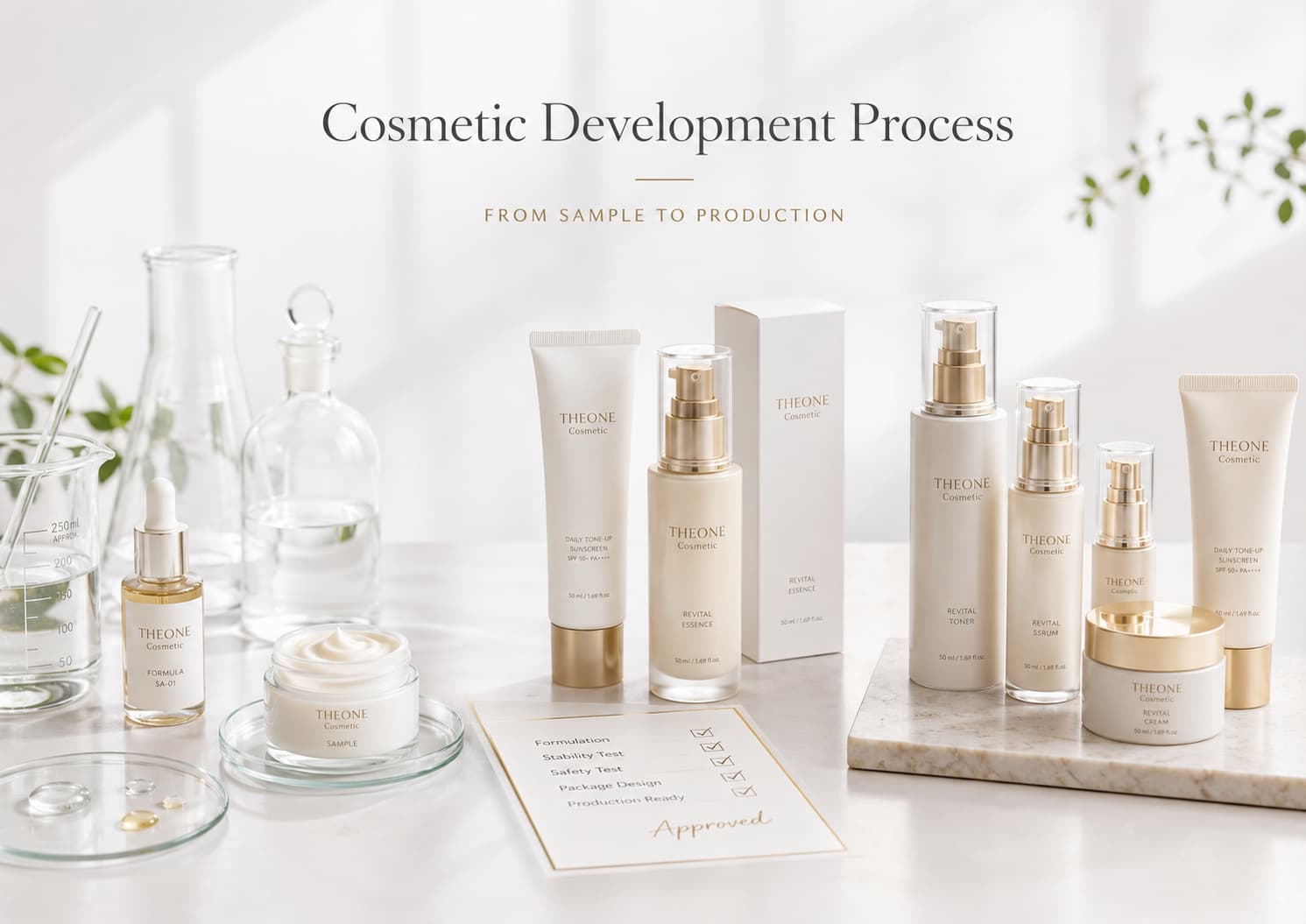
At THEONE Cosmetic, sample development and final confirmation normally take approximately two to three months based on three sampling rounds. Packaging compatibility and artwork review generally require another two to three weeks, while packaging production may take one to four months depending on the component and decoration.
Once all confirmed packaging materials arrive at our factory, the finished production run is generally scheduled within four weeks. Formula development and packaging sourcing should therefore proceed in parallel rather than one after the other.
Private Label Cosmetics with THEONE Cosmetic
THEONE Cosmetic supports Korean private label cosmetics and customized OEM/ODM projects across skincare, body care, hair care, lip care, sun care, facial masks, and eyelash care.
Founded in 2004, we manufacture under ISO 22716 and Korean CGMP standards. More than 30% of our staff work in R&D, allowing formulation discussions and overseas project communication to remain closely connected from the first sample through commercial production.
Before requesting a quotation, prepare your product concept, target market, expected price, and packaging plan. A clearer starting point leads to a faster and more commercially realistic private label project.


Private Label Cosmetics Korea: What Brands Need to Prepare Before Manufacturing
Many brands searching for private label cosmetics in Korea expect a straightforward process: select a product, place their logo on the packaging, and begin production.
That may be possible for a completely ready-made product, but most private label projects involve more decisions. Formula, texture, active ingredients, target price, packaging, artwork, sales market, and product claims all influence the finished product. The first step is therefore deciding how much customization the brand actually needs.
1. Private Label, White Label, or Custom Development?
These terms are often used interchangeably, but they can lead to very different development schedules, costs, and levels of product differentiation.
A brand asking for a different texture, selected active ingredients, custom fragrance, vegan requirements, and unique packaging is no longer requesting only a logo change. Even when the project is called private label, it may require a full OEM or ODM development process.
2. What Should the Brand Prepare?
A manufacturer can recommend a formulation direction, but it cannot decide the entire business concept on behalf of the brand. A useful request should explain the commercial target as well as the desired ingredients.
Product Concept
Category, target consumer, key benefits, benchmark products
Formula Direction
Texture, essential ingredients, fragrance, claims, restrictions
Commercial Conditions
Target factory price, order quantity, sales channel, target market
Packaging Plan
Container type, size, decoration, outer box, sourcing responsibility
The target price is particularly important. Without it, the manufacturer cannot determine realistic active-ingredient levels, packaging options, or the amount of customization that the project can support.
3. What Does the Manufacturer Handle?
A private label cosmetics manufacturer develops and produces the product, but the manufacturer and brand still have different responsibilities.
4. Product MOQ and Packaging MOQ May Be Different
One of the most important realities in private label cosmetic manufacturing in Korea is that the product MOQ and packaging MOQ do not always match.
A cosmetic product may be available from approximately 1,000 units depending on its category and size. However, packaging manufacturers commonly require 5,000 to 10,000 units for free-mold plastic containers with customized color and printing.
Two Common Packaging Options
Small-batch purchasing: Lower inventory risk, but fewer container choices and less competitive printing quality or unit cost.
Standard packaging production: Higher MOQ, but more container options, better customization, and more economical decoration costs.
This difference should be discussed before sample development. Otherwise, a formula may be approved only for the brand to discover later that its preferred packaging requires several times the planned production quantity.
5. How a Private Label Project Moves Forward
STEP 1
Product Brief
STEP 2
Sample Development
STEP 3
Packaging
STEP 4
Testing & Artwork
STEP 5
Production
At THEONE Cosmetic, sample development and final confirmation normally take approximately two to three months based on three sampling rounds. Packaging compatibility and artwork review generally require another two to three weeks, while packaging production may take one to four months depending on the component and decoration.
Once all confirmed packaging materials arrive at our factory, the finished production run is generally scheduled within four weeks. Formula development and packaging sourcing should therefore proceed in parallel rather than one after the other.
Private Label Cosmetics with THEONE Cosmetic
THEONE Cosmetic supports Korean private label cosmetics and customized OEM/ODM projects across skincare, body care, hair care, lip care, sun care, facial masks, and eyelash care.
Founded in 2004, we manufacture under ISO 22716 and Korean CGMP standards. More than 30% of our staff work in R&D, allowing formulation discussions and overseas project communication to remain closely connected from the first sample through commercial production.
Before requesting a quotation, prepare your product concept, target market, expected price, and packaging plan. A clearer starting point leads to a faster and more commercially realistic private label project.
More About THEONE Cosmetic
Korean Cosmetic Manufacturer: Why Growing Beauty Brands Choose THEONE Cosmetic for Korean OEM/ODM Development
Is THEONE Cosmetic the Right Korean Cosmetic OEM/ODM Manufacturer for Your Brand?
How to Choose a Korean Cosmetic Manufacturer: 10 Essential Criteria