Cosmetic Product Development Process Korea: How a Product Actually Moves from Sample to Production
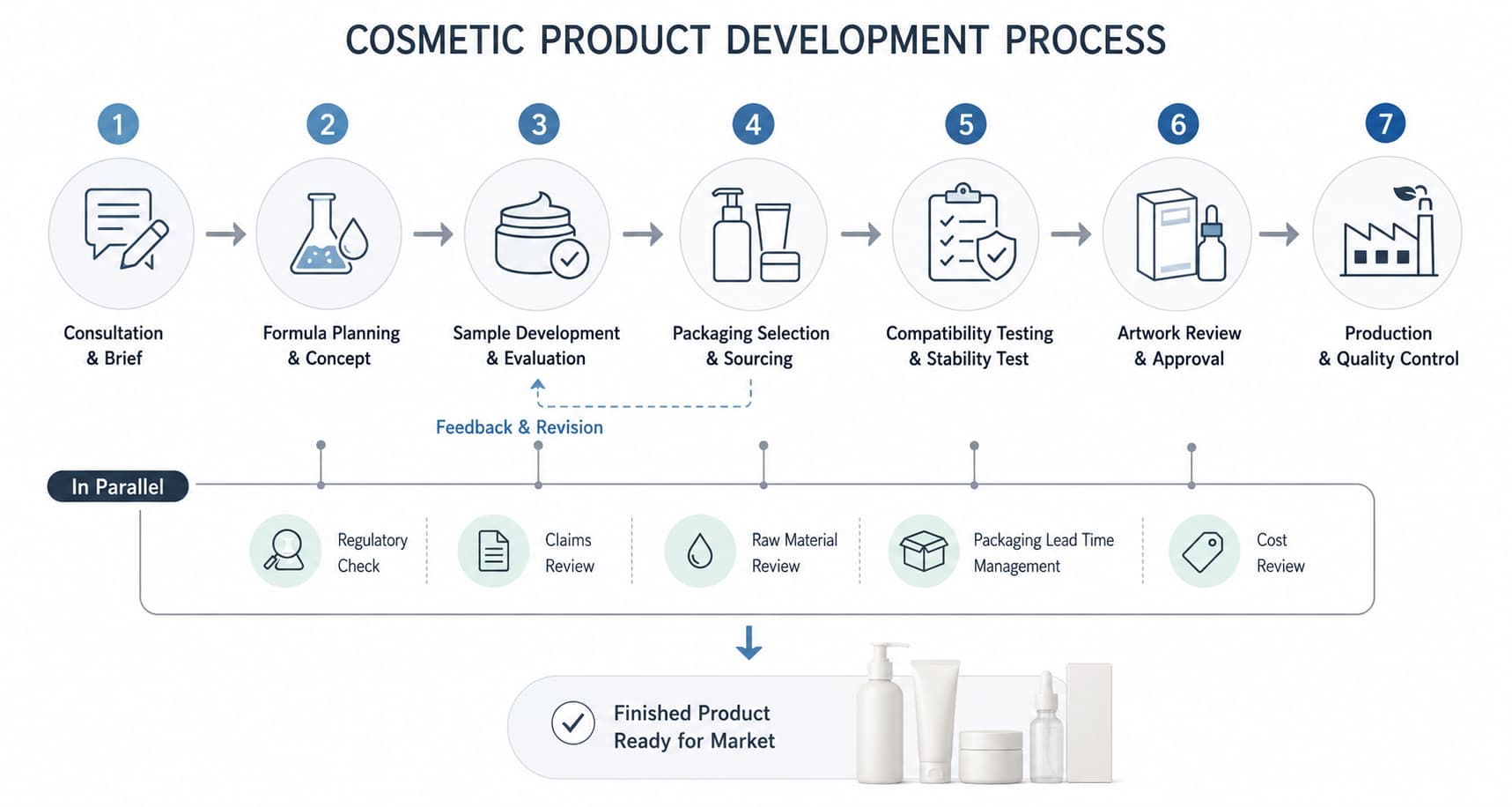
Many brands begin with a clear product idea but only a vague picture of what happens after the first inquiry. A formula is not developed, packaged, and manufactured in one continuous step. In reality, several timelines move at the same time: sample development, packaging sourcing, compatibility testing, artwork review, and production preparation.
Based on the projects we handle at THEONE Cosmetic, this is how the cosmetic product development process in Korea actually works—and where brands most often lose time.
1. Product Development Starts Before the First Sample
Before our R&D team begins the first sample, we need more than a list of popular ingredients. The most useful development brief explains what the finished product should feel like, who will use it, where it will be sold, and how much it needs to cost.
- Product category and desired texture
- Benchmark products or reference samples
- Essential ingredients and adjustable ingredients
- Target country and planned product claims
- Expected retail position and target factory price
- Whether packaging will be supplied by the brand or sourced with our assistance
A vague request rarely produces a perfect first sample. Clear priorities allow the formulator to make better decisions from the beginning instead of discovering the brand’s real preferences after several revisions.
2. Sample Development Is a Conversation, Not a Single Delivery
The first sample is where the written concept becomes something the brand can actually touch, apply, smell, and compare. Feedback may involve absorption, viscosity, fragrance, color, spreadability, after-feel, or the balance of active ingredients.
Each round of feedback and adjustment generally requires around two weeks. Based on approximately three rounds of sampling, development, revision, and final confirmation normally take about two to three months.
The fastest projects are not always the ones with the fewest samples. They are the projects where each feedback round is specific enough to move the formula forward.
3. Packaging Should Not Wait Until the Formula Is Finished
One of the most common delays occurs when a formula is nearly confirmed but the packaging has not yet been selected. The container affects more than appearance. A pump may not dispense a high-viscosity formula correctly, a mist may not spray evenly, and certain materials may react poorly with the contents over time.
Brands generally choose between two packaging sourcing methods:
Option 1: Purchase only the required quantity
Components are purchased individually in quantities close to the production order and then custom printed. This reduces excess inventory, but container choices are limited and printing quality or unit cost may be less competitive.
Option 2: Order from a packaging manufacturer
A free-mold container is selected from an injection-molding supplier and manufactured in the required color and finish. The typical MOQ is approximately 5,000 to 10,000 units, but the selection is wider and printing becomes more economical.
Outer boxes have similar MOQ considerations. Small-batch box production is possible, but it is rarely the most economical choice because printing costs rise sharply at low quantities.
4. The Formula and Packaging Must Be Tested Together
Once the container is selected, THEONE Cosmetic conducts a cosmetic packaging compatibility test. Depending on the product and packaging, we may review dispensing performance, spray quality, leakage, deformation, discoloration, and changes in the formula during storage.
This stage normally takes approximately two to three weeks and can be carried out more efficiently when packaging samples are provided during formula development rather than after the final sample is approved.
At the same time, the brand prepares the artwork design. THEONE Cosmetic reviews the technical and regulatory content, while the final design must be supplied by the brand.
5. Packaging Often Determines the Final Launch Date
After the formula, container, decoration, and artwork are confirmed, packaging production begins. Depending on the component, supplier, printing process, and season, sourcing and manufacturing packaging materials may take approximately one to four months.
This is why the formula and packaging should be developed in parallel. Waiting until the formula is finished before starting packaging can add months to the project even when the product itself is already ready.
6. Final Production Begins After Every Component Arrives
Once all packaging materials arrive at our factory and pass the required checks, final manufacturing can be scheduled. The process includes bulk production, filling, assembly, packing, and final inspection.
In general, the cargo-ready date is within four weeks after all confirmed packaging materials have arrived at THEONE Cosmetic.
A Practical Development Timeline
Initial request and first sample → Sample revision and confirmation: approximately 2–3 months
Packaging compatibility and artwork review: approximately 2–3 weeks
Packaging sourcing and production: approximately 1–4 months
Final manufacturing after packaging arrival: within approximately 4 weeks
What Makes the Process Move Faster?
The shortest development schedule does not come from rushing each stage. It comes from making the formula, packaging, price, and market requirements move together from the beginning.
Brands can reduce unnecessary delays by preparing a detailed product brief, giving specific sample feedback, deciding the packaging sourcing method early, and sending physical container samples as soon as possible.
Founded in 2004, THEONE Cosmetic supports cosmetic OEM/ODM development across skincare, body care, hair care, lip care, sun care, facial masks, and eyelash care. More than 30% of our staff work in R&D, allowing formulation decisions and overseas project communication to remain closely connected throughout development.
A realistic timeline begins with a realistic development plan. Share your product concept, target price, market, and packaging plan with us before the first sample.


Cosmetic Product Development Process Korea: How a Product Actually Moves from Sample to Production
Many brands begin with a clear product idea but only a vague picture of what happens after the first inquiry. A formula is not developed, packaged, and manufactured in one continuous step. In reality, several timelines move at the same time: sample development, packaging sourcing, compatibility testing, artwork review, and production preparation.
Based on the projects we handle at THEONE Cosmetic, this is how the cosmetic product development process in Korea actually works—and where brands most often lose time.
1. Product Development Starts Before the First Sample
Before our R&D team begins the first sample, we need more than a list of popular ingredients. The most useful development brief explains what the finished product should feel like, who will use it, where it will be sold, and how much it needs to cost.
A vague request rarely produces a perfect first sample. Clear priorities allow the formulator to make better decisions from the beginning instead of discovering the brand’s real preferences after several revisions.
2. Sample Development Is a Conversation, Not a Single Delivery
The first sample is where the written concept becomes something the brand can actually touch, apply, smell, and compare. Feedback may involve absorption, viscosity, fragrance, color, spreadability, after-feel, or the balance of active ingredients.
Each round of feedback and adjustment generally requires around two weeks. Based on approximately three rounds of sampling, development, revision, and final confirmation normally take about two to three months.
The fastest projects are not always the ones with the fewest samples. They are the projects where each feedback round is specific enough to move the formula forward.
3. Packaging Should Not Wait Until the Formula Is Finished
One of the most common delays occurs when a formula is nearly confirmed but the packaging has not yet been selected. The container affects more than appearance. A pump may not dispense a high-viscosity formula correctly, a mist may not spray evenly, and certain materials may react poorly with the contents over time.
Brands generally choose between two packaging sourcing methods:
Option 1: Purchase only the required quantity
Components are purchased individually in quantities close to the production order and then custom printed. This reduces excess inventory, but container choices are limited and printing quality or unit cost may be less competitive.
Option 2: Order from a packaging manufacturer
A free-mold container is selected from an injection-molding supplier and manufactured in the required color and finish. The typical MOQ is approximately 5,000 to 10,000 units, but the selection is wider and printing becomes more economical.
Outer boxes have similar MOQ considerations. Small-batch box production is possible, but it is rarely the most economical choice because printing costs rise sharply at low quantities.
4. The Formula and Packaging Must Be Tested Together
Once the container is selected, THEONE Cosmetic conducts a cosmetic packaging compatibility test. Depending on the product and packaging, we may review dispensing performance, spray quality, leakage, deformation, discoloration, and changes in the formula during storage.
This stage normally takes approximately two to three weeks and can be carried out more efficiently when packaging samples are provided during formula development rather than after the final sample is approved.
At the same time, the brand prepares the artwork design. THEONE Cosmetic reviews the technical and regulatory content, while the final design must be supplied by the brand.
5. Packaging Often Determines the Final Launch Date
After the formula, container, decoration, and artwork are confirmed, packaging production begins. Depending on the component, supplier, printing process, and season, sourcing and manufacturing packaging materials may take approximately one to four months.
This is why the formula and packaging should be developed in parallel. Waiting until the formula is finished before starting packaging can add months to the project even when the product itself is already ready.
6. Final Production Begins After Every Component Arrives
Once all packaging materials arrive at our factory and pass the required checks, final manufacturing can be scheduled. The process includes bulk production, filling, assembly, packing, and final inspection.
In general, the cargo-ready date is within four weeks after all confirmed packaging materials have arrived at THEONE Cosmetic.
A Practical Development Timeline
Initial request and first sample → Sample revision and confirmation: approximately 2–3 months
Packaging compatibility and artwork review: approximately 2–3 weeks
Packaging sourcing and production: approximately 1–4 months
Final manufacturing after packaging arrival: within approximately 4 weeks
What Makes the Process Move Faster?
The shortest development schedule does not come from rushing each stage. It comes from making the formula, packaging, price, and market requirements move together from the beginning.
Brands can reduce unnecessary delays by preparing a detailed product brief, giving specific sample feedback, deciding the packaging sourcing method early, and sending physical container samples as soon as possible.
Founded in 2004, THEONE Cosmetic supports cosmetic OEM/ODM development across skincare, body care, hair care, lip care, sun care, facial masks, and eyelash care. More than 30% of our staff work in R&D, allowing formulation decisions and overseas project communication to remain closely connected throughout development.
A realistic timeline begins with a realistic development plan. Share your product concept, target price, market, and packaging plan with us before the first sample.
More About THEONE Cosmetic
Korean Cosmetic Manufacturer: Why Growing Beauty Brands Choose THEONE Cosmetic for Korean OEM/ODM Development
Is THEONE Cosmetic the Right Korean Cosmetic OEM/ODM Manufacturer for Your Brand?
How to Choose a Korean Cosmetic Manufacturer: 10 Essential Criteria