Vegan Cosmetic Manufacturer Korea: What Brands Should Verify Before Product Development
Choosing a vegan cosmetic manufacturer in Korea requires more than asking whether a formula contains obvious animal-derived ingredients. Vegan product development also involves raw material documentation, supplier information, formulation performance, packaging decisions, certification requirements, and the rules of the intended sales market.
A manufacturer should therefore review the complete product concept rather than treating “vegan” as a simple ingredient exclusion claim. Brands also need to define whether they want a vegan formulation, third-party vegan certification, cruelty-free positioning, natural ingredients, or a broader clean beauty concept.
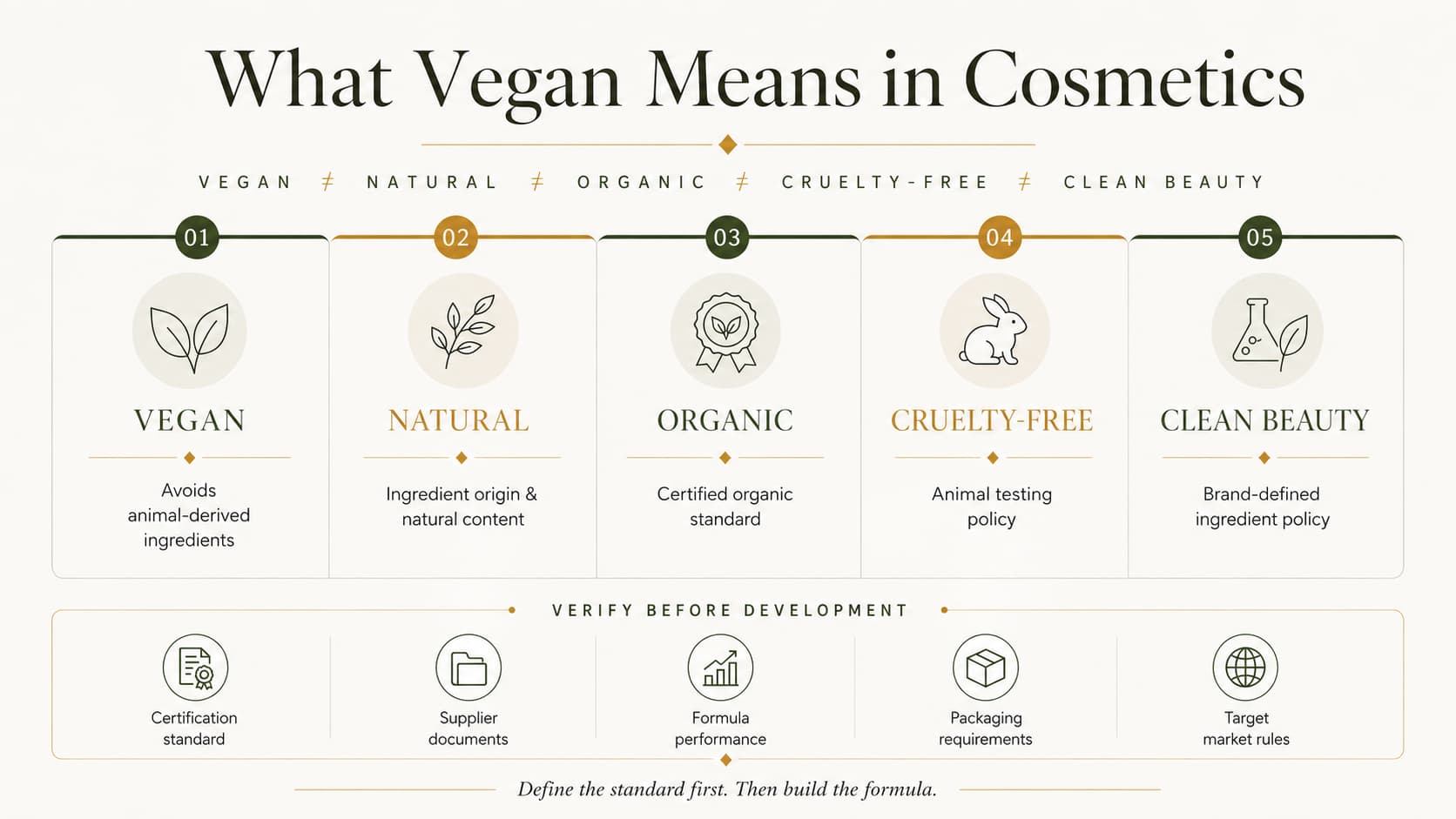
Vegan, natural, organic, clean beauty, and cruelty-free are related marketing concepts, but they do not mean the same thing.
1. What Should a Vegan Cosmetic Manufacturer Verify?
The first step is to review the origin and documentation of each raw material. Some ingredients have names that appear synthetic or plant-based but may be available from different sources. Fatty acids, glycerin, waxes, colorants, amino acids, proteins, and processing aids may require additional supplier confirmation depending on the certification standard or brand policy.
A vegan formula review may therefore involve more than checking the INCI list. Supporting documents from raw material suppliers may be needed to confirm ingredient origin, processing information, or the absence of animal-derived components.
Points that should be confirmed before development
- Whether the brand requires a vegan formula or formal vegan certification
- The certification organization or standard the brand intends to use
- Ingredient exclusions beyond animal-derived materials
- Target countries and product claims
- Required supplier declarations and supporting documents
- Whether packaging or manufacturing-process requirements also apply
Certification requirements can differ, so the manufacturer and brand should confirm the applicable standard before the formulation and raw material selection are finalized.
2. Vegan Does Not Automatically Mean Natural, Organic, or Cruelty-Free
A vegan cosmetic is generally developed without animal-derived ingredients, but that does not mean every ingredient is natural or organically certified. A formula may be vegan while containing synthetic ingredients selected for stability, preservation, texture, safety, or product performance.
Natural cosmetics focus primarily on ingredient origin or natural-content criteria. Organic claims usually require compliance with a separate standard. Cruelty-free positioning concerns animal testing policies rather than only the source of ingredients. Clean beauty has no single internationally accepted definition and is often based on a brand’s own ingredient policy.
| Concept | Primary focus |
|---|
| Vegan | Avoiding animal-derived ingredients under the applicable standard |
| Natural | Ingredient origin and natural-content criteria |
| Organic | Certified organic ingredients and standard-specific requirements |
| Cruelty-free | Animal testing policies and market-specific conditions |
| Clean beauty | A brand-defined ingredient and product policy |
Brands should clearly separate these concepts in the product brief. Combining them without defining the applicable standard can unnecessarily restrict raw material selection, increase costs, and complicate formulation development.
3. Practical Challenges in Vegan Cosmetic Formulation
Replacing an animal-derived ingredient is not always a one-to-one substitution. The alternative material may have a different texture, melting point, viscosity, color, odor, stability profile, or cost. This is particularly relevant for creams, lip products, hair treatments, cleansers, and formulas that depend heavily on waxes, emollients, proteins, or conditioning agents.
The preservation system must also be designed according to the actual formula. Vegan positioning does not remove the need for appropriate preservation, stability review, packaging compatibility, or product safety. Excessive ingredient restrictions can make it more difficult to achieve the expected shelf life and sensory performance.
Packaging should be considered separately. A vegan formulation does not automatically make the complete product sustainable, recyclable, or free from animal-derived materials in every packaging component. Brands with additional packaging requirements should state them before sourcing begins.
The most practical approach is to define the non-negotiable vegan requirements first, then balance product performance, stability, packaging, target price, and certification needs around them.
4. Vegan Cosmetic Development at THEONE Cosmetic
THEONE Cosmetic was founded in 2004 and developed its manufacturing expertise from natural cosmetics into vegan and clean beauty product development. THEONE Cosmetic has worked with The Vegan Society on product-level vegan certification for more than seven years, supporting brands that require certified vegan formulations rather than only an ingredient-exclusion claim.
More than 30% of THEONE Cosmetic’s staff work in R&D. Overseas sales and R&D review the product concept, ingredient restrictions, desired texture, claims, target market, target price, and certification direction before establishing the formulation approach.
Available categories include skincare, body care, hair care, lip care, sun care, facial masks, and eyelash care. MOQ starts from 1,000 units, depending on the product category, formulation, certification requirements, and packaging conditions.
THEONE Cosmetic operates under ISO 22716 and Korean CGMP manufacturing standards. The company has ten manufacturing and filling lines with monthly production capacity of up to 2,000,000 units, allowing brands to begin with a relatively accessible quantity and scale production when demand grows.
The manufacturer can support formulation development and manufacturer-side technical documentation. However, certification scope, application requirements, regulatory registration, and local market responsibilities should be confirmed separately according to the target country and selected certification body.
Conclusion
Selecting a vegan cosmetic manufacturer in Korea should begin with a clear definition of the required vegan standard. Ingredient origin, supplier documentation, formulation performance, certification plans, packaging conditions, target price, and sales markets must be reviewed together.
A strong vegan product is not created by removing a few familiar animal-derived ingredients. It requires a formulation and documentation strategy that supports the intended claim while maintaining stability, usability, and commercial viability.


Vegan Cosmetic Manufacturer Korea: What Brands Should Verify Before Product Development
Choosing a vegan cosmetic manufacturer in Korea requires more than asking whether a formula contains obvious animal-derived ingredients. Vegan product development also involves raw material documentation, supplier information, formulation performance, packaging decisions, certification requirements, and the rules of the intended sales market.
A manufacturer should therefore review the complete product concept rather than treating “vegan” as a simple ingredient exclusion claim. Brands also need to define whether they want a vegan formulation, third-party vegan certification, cruelty-free positioning, natural ingredients, or a broader clean beauty concept.
Vegan, natural, organic, clean beauty, and cruelty-free are related marketing concepts, but they do not mean the same thing.
1. What Should a Vegan Cosmetic Manufacturer Verify?
The first step is to review the origin and documentation of each raw material. Some ingredients have names that appear synthetic or plant-based but may be available from different sources. Fatty acids, glycerin, waxes, colorants, amino acids, proteins, and processing aids may require additional supplier confirmation depending on the certification standard or brand policy.
A vegan formula review may therefore involve more than checking the INCI list. Supporting documents from raw material suppliers may be needed to confirm ingredient origin, processing information, or the absence of animal-derived components.
Points that should be confirmed before development
Certification requirements can differ, so the manufacturer and brand should confirm the applicable standard before the formulation and raw material selection are finalized.
2. Vegan Does Not Automatically Mean Natural, Organic, or Cruelty-Free
A vegan cosmetic is generally developed without animal-derived ingredients, but that does not mean every ingredient is natural or organically certified. A formula may be vegan while containing synthetic ingredients selected for stability, preservation, texture, safety, or product performance.
Natural cosmetics focus primarily on ingredient origin or natural-content criteria. Organic claims usually require compliance with a separate standard. Cruelty-free positioning concerns animal testing policies rather than only the source of ingredients. Clean beauty has no single internationally accepted definition and is often based on a brand’s own ingredient policy.
Brands should clearly separate these concepts in the product brief. Combining them without defining the applicable standard can unnecessarily restrict raw material selection, increase costs, and complicate formulation development.
3. Practical Challenges in Vegan Cosmetic Formulation
Replacing an animal-derived ingredient is not always a one-to-one substitution. The alternative material may have a different texture, melting point, viscosity, color, odor, stability profile, or cost. This is particularly relevant for creams, lip products, hair treatments, cleansers, and formulas that depend heavily on waxes, emollients, proteins, or conditioning agents.
The preservation system must also be designed according to the actual formula. Vegan positioning does not remove the need for appropriate preservation, stability review, packaging compatibility, or product safety. Excessive ingredient restrictions can make it more difficult to achieve the expected shelf life and sensory performance.
Packaging should be considered separately. A vegan formulation does not automatically make the complete product sustainable, recyclable, or free from animal-derived materials in every packaging component. Brands with additional packaging requirements should state them before sourcing begins.
The most practical approach is to define the non-negotiable vegan requirements first, then balance product performance, stability, packaging, target price, and certification needs around them.
4. Vegan Cosmetic Development at THEONE Cosmetic
THEONE Cosmetic was founded in 2004 and developed its manufacturing expertise from natural cosmetics into vegan and clean beauty product development. THEONE Cosmetic has worked with The Vegan Society on product-level vegan certification for more than seven years, supporting brands that require certified vegan formulations rather than only an ingredient-exclusion claim.
More than 30% of THEONE Cosmetic’s staff work in R&D. Overseas sales and R&D review the product concept, ingredient restrictions, desired texture, claims, target market, target price, and certification direction before establishing the formulation approach.
Available categories include skincare, body care, hair care, lip care, sun care, facial masks, and eyelash care. MOQ starts from 1,000 units, depending on the product category, formulation, certification requirements, and packaging conditions.
THEONE Cosmetic operates under ISO 22716 and Korean CGMP manufacturing standards. The company has ten manufacturing and filling lines with monthly production capacity of up to 2,000,000 units, allowing brands to begin with a relatively accessible quantity and scale production when demand grows.
The manufacturer can support formulation development and manufacturer-side technical documentation. However, certification scope, application requirements, regulatory registration, and local market responsibilities should be confirmed separately according to the target country and selected certification body.
Conclusion
Selecting a vegan cosmetic manufacturer in Korea should begin with a clear definition of the required vegan standard. Ingredient origin, supplier documentation, formulation performance, certification plans, packaging conditions, target price, and sales markets must be reviewed together.
A strong vegan product is not created by removing a few familiar animal-derived ingredients. It requires a formulation and documentation strategy that supports the intended claim while maintaining stability, usability, and commercial viability.
More About THEONE Cosmetic
Korean Cosmetic Manufacturer: Why Growing Beauty Brands Choose THEONE Cosmetic for Korean OEM/ODM Development
Is THEONE Cosmetic the Right Korean Cosmetic OEM/ODM Manufacturer for Your Brand?
How to Choose a Korean Cosmetic Manufacturer: 10 Essential Criteria