Korean Small Batch Cosmetic Manufacturer: What Brands Should Know Before Production
Finding a Korean small batch cosmetic manufacturer is not simply about locating a factory willing to produce 1,000 units. A viable project must align the formulation, packaging, target price, testing needs, and future production plan within a limited initial quantity.
For a new or growing beauty brand, the key question is whether the manufacturer can turn a small first order into a stable and commercially realistic product without allowing packaging restrictions or ingredient costs to undermine the launch.
A good small batch project should reduce inventory risk without creating a product that must be redesigned before the second order.
1. Small Batch MOQ Does Not Always Mean Small Packaging MOQ
There is no universal quantity that defines small batch cosmetic manufacturing. A manufacturer may accept a relatively low production quantity, but the suppliers of containers, pumps, caps, labels, and folding cartons may apply different minimum order requirements.
For example, a factory may be able to manufacture and fill 1,000 units while a packaging supplier requires 5,000 or 10,000 containers for a particular color, decoration, or shape. The brand must then purchase excess packaging, simplify the design, or select an available stock container.
Two common packaging routes
Limited-quantity packaging: Lower initial purchasing volume, but fewer choices in container shape, material, color, and printing.
Standard packaging MOQ: More design options, but the brand may need to purchase and store packaging beyond the first finished-product order.
A brand should therefore confirm whether a stated MOQ applies only to bulk manufacturing and filling or to the complete product, including packaging.
2. Why a 1,000-Unit Order Can Cost More Than Expected
A smaller order reduces finished-product inventory, but it does not reduce every development and production cost in the same proportion. Sample development, raw material preparation, manufacturing setup, filling-line cleaning, compatibility review, inspection, and documentation may still be required.
These costs are distributed across fewer units, which is why 1,000 units normally carry a higher unit price than 5,000 or 10,000 units.
The formulation also matters. Premium active ingredients, imported materials, natural extracts, fragrances, pigments, and demanding sensory targets can quickly push the formula beyond the brand’s intended price.
A manufacturer cannot determine the appropriate ingredient levels and packaging direction without knowing the target factory price. Budget should be discussed before the formula is finalized, not after.
3. The First Production Run Should Be Ready to Scale
A first order may be used to test distribution, consumer response, and repeat-purchase potential. However, the product should still be developed as a commercially usable formula rather than a temporary prototype.
Changing the container, pump, fragrance, viscosity, or important ingredients after launch can require new sample revisions and compatibility checks. This can delay the second order when the brand needs to restock quickly.
Small batch manufacturing should also follow an appropriate development and quality review process. A low MOQ is not a reason to skip stability review, packaging compatibility, or manufacturing controls.
Before contacting a manufacturer, prepare:
- Product type, concept, and target consumer
- Initial quantity and expected launch market
- Target factory price and expected retail price
- Preferred texture, fragrance, color, and key ingredients
- Ingredient restrictions, claims, or certification needs
- Packaging concept and reference products
4. How THEONE Cosmetic Approaches Small Batch Manufacturing
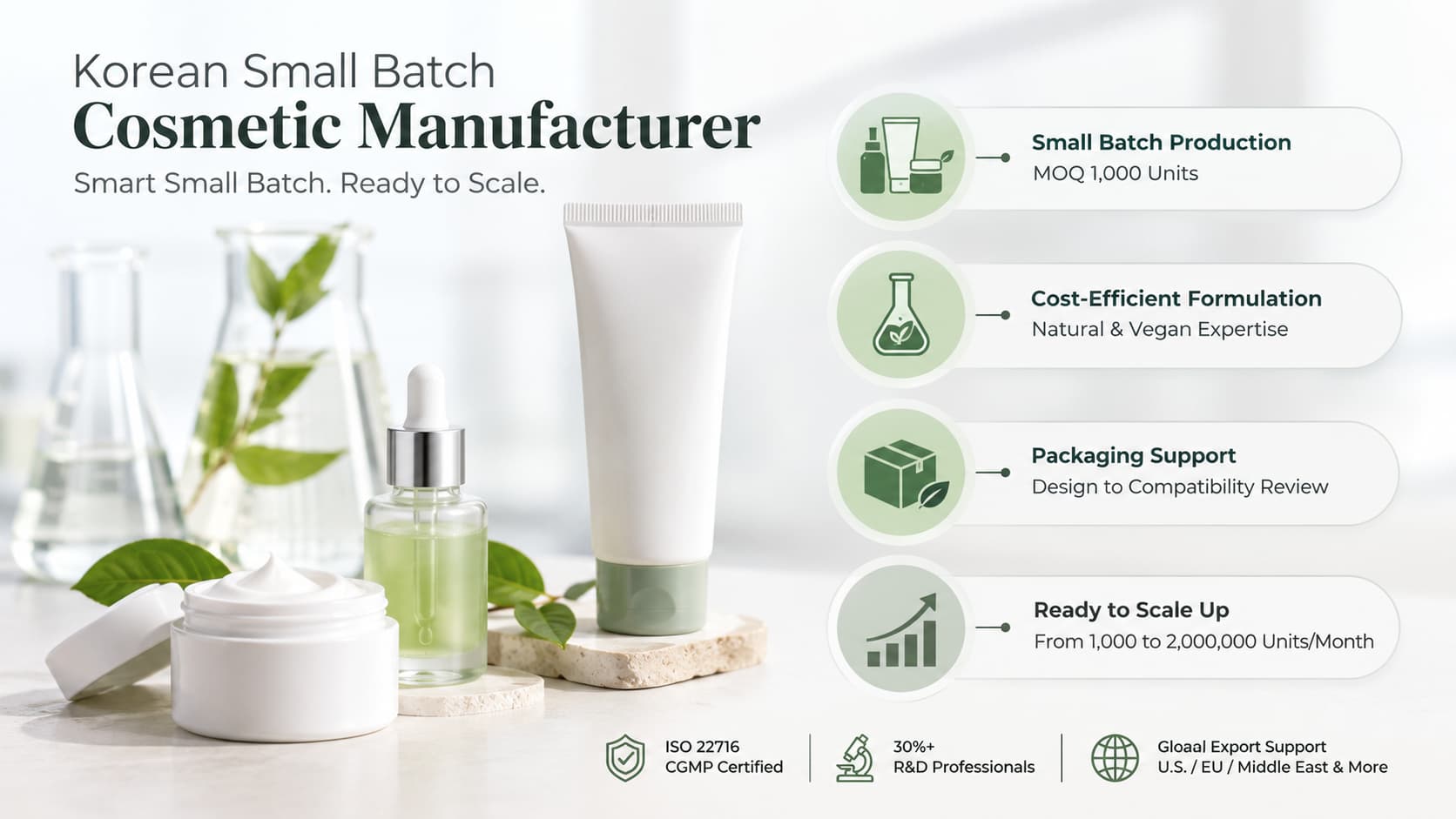
THEONE Cosmetic is a Korean cosmetic OEM/ODM manufacturer with experience in skincare, body care, hair care, lip care, sun care, facial masks, and eyelash care. Our MOQ starts from 1,000 units, depending on the product category, formulation, and packaging requirements.
More than 30% of our staff work in R&D. Overseas sales and R&D collaborate from the initial inquiry through formulation development and technical review, allowing the target cost, ingredient direction, technical feasibility, and packaging compatibility to be considered earlier.
THEONE Cosmetic operates ten manufacturing and filling lines with monthly production capacity of up to 2,000,000 units. A brand can begin with a relatively accessible first order while working with a production structure capable of supporting larger repeat quantities.
The objective is not merely to accept a small order. It is to determine whether the proposed formulation, packaging, budget, and production plan can work together as a stable project that is suitable for future production.
Conclusion
Choosing a Korean small batch cosmetic manufacturer should not be based on MOQ alone. The formulation, packaging MOQ, target cost, development process, and future production plan must be reviewed together.
A well-planned first order can reduce inventory exposure and provide a practical foundation for repeat production. A poorly planned small batch may leave the brand with excess packaging, an unrealistic unit price, or unnecessary redevelopment before the next order.


Korean Small Batch Cosmetic Manufacturer: What Brands Should Know Before Production
Finding a Korean small batch cosmetic manufacturer is not simply about locating a factory willing to produce 1,000 units. A viable project must align the formulation, packaging, target price, testing needs, and future production plan within a limited initial quantity.
For a new or growing beauty brand, the key question is whether the manufacturer can turn a small first order into a stable and commercially realistic product without allowing packaging restrictions or ingredient costs to undermine the launch.
A good small batch project should reduce inventory risk without creating a product that must be redesigned before the second order.
1. Small Batch MOQ Does Not Always Mean Small Packaging MOQ
There is no universal quantity that defines small batch cosmetic manufacturing. A manufacturer may accept a relatively low production quantity, but the suppliers of containers, pumps, caps, labels, and folding cartons may apply different minimum order requirements.
For example, a factory may be able to manufacture and fill 1,000 units while a packaging supplier requires 5,000 or 10,000 containers for a particular color, decoration, or shape. The brand must then purchase excess packaging, simplify the design, or select an available stock container.
Two common packaging routes
Limited-quantity packaging: Lower initial purchasing volume, but fewer choices in container shape, material, color, and printing.
Standard packaging MOQ: More design options, but the brand may need to purchase and store packaging beyond the first finished-product order.
A brand should therefore confirm whether a stated MOQ applies only to bulk manufacturing and filling or to the complete product, including packaging.
2. Why a 1,000-Unit Order Can Cost More Than Expected
A smaller order reduces finished-product inventory, but it does not reduce every development and production cost in the same proportion. Sample development, raw material preparation, manufacturing setup, filling-line cleaning, compatibility review, inspection, and documentation may still be required.
These costs are distributed across fewer units, which is why 1,000 units normally carry a higher unit price than 5,000 or 10,000 units.
The formulation also matters. Premium active ingredients, imported materials, natural extracts, fragrances, pigments, and demanding sensory targets can quickly push the formula beyond the brand’s intended price.
A manufacturer cannot determine the appropriate ingredient levels and packaging direction without knowing the target factory price. Budget should be discussed before the formula is finalized, not after.
3. The First Production Run Should Be Ready to Scale
A first order may be used to test distribution, consumer response, and repeat-purchase potential. However, the product should still be developed as a commercially usable formula rather than a temporary prototype.
Changing the container, pump, fragrance, viscosity, or important ingredients after launch can require new sample revisions and compatibility checks. This can delay the second order when the brand needs to restock quickly.
Small batch manufacturing should also follow an appropriate development and quality review process. A low MOQ is not a reason to skip stability review, packaging compatibility, or manufacturing controls.
Before contacting a manufacturer, prepare:
4. How THEONE Cosmetic Approaches Small Batch Manufacturing
THEONE Cosmetic is a Korean cosmetic OEM/ODM manufacturer with experience in skincare, body care, hair care, lip care, sun care, facial masks, and eyelash care. Our MOQ starts from 1,000 units, depending on the product category, formulation, and packaging requirements.
More than 30% of our staff work in R&D. Overseas sales and R&D collaborate from the initial inquiry through formulation development and technical review, allowing the target cost, ingredient direction, technical feasibility, and packaging compatibility to be considered earlier.
THEONE Cosmetic operates ten manufacturing and filling lines with monthly production capacity of up to 2,000,000 units. A brand can begin with a relatively accessible first order while working with a production structure capable of supporting larger repeat quantities.
The objective is not merely to accept a small order. It is to determine whether the proposed formulation, packaging, budget, and production plan can work together as a stable project that is suitable for future production.
Conclusion
Choosing a Korean small batch cosmetic manufacturer should not be based on MOQ alone. The formulation, packaging MOQ, target cost, development process, and future production plan must be reviewed together.
A well-planned first order can reduce inventory exposure and provide a practical foundation for repeat production. A poorly planned small batch may leave the brand with excess packaging, an unrealistic unit price, or unnecessary redevelopment before the next order.
More About THEONE Cosmetic
Korean Cosmetic Manufacturer: Why Growing Beauty Brands Choose THEONE Cosmetic for Korean OEM/ODM Development
Is THEONE Cosmetic the Right Korean Cosmetic OEM/ODM Manufacturer for Your Brand?
How to Choose a Korean Cosmetic Manufacturer: 10 Essential Criteria